Get to know our Max Planck School of Photonics Fellows: Prof. Dr. Maria Chekhova
A series of interviews
In today's Fellow interview, we talked to Prof. Dr. Maria Chekhova about the future of photonics, the Max Planck School of Photonics (MPSP), and her research. She is a professor at Friedrich-Alexander University in Erlangen and also heads the “Quantum Radiation” research group at the Max Planck Institute for the Physics of Light (MPI). She has been a Fellow of the MPSP since 2019.

Could you explain the main focus of your research in photonics and what initially drew you to this area of study?
I work in quantum optics and actually, I started long ago: my first task was given to me when I was just a second-year student. But since then, I drifted within this field.
I am an experimentalist. I was fond of repairing things or making things even when I was a child. I remember two of my projects. In one, I made flippers for hands to swim faster. It was a complicated project! Then, also as a child, I made a toy parachute out of an umbrella. I would also repair my bike myself. And, of course, I find experiment much more exciting than theory. I planned to become a theoretician, but I found it boring. So, I switched to experiment.
As a fellow, what has been your biggest challenge in the field of photonics?
I think I haven’t overcome my biggest challenge yet, which is the generation of photon triplet states.
But thinking of the challenges I faced so far, it is hard to say which one was the biggest. I don't like the idea of setting a challenging experimental goal and then approaching this goal infinitely long. In experimenting, when you are looking for something, you always find something else. And this is why experiment is so exciting: your efforts are not wasted.
For instance, we were looking for photon triplets, and on the way we came to the idea to generate photon pairs at nanoscale. I would say my best results are found accidentally.
Collaboration plays a major role in research. What has been your most rewarding collaborative experience?
I have a lot of collaborators all around the world: in Denmark, in USA, in the Czech Republic, in Israel, in Italy, and in Germany of course. I collaborate with very different groups, very different people, usually whenever we do complementary things. For instance, some of my colleagues fabricate nanostructures with which we work. Also, I collaborate a lot with theoreticians.
What are some of the most surprising or unexpected applications of photonics that you encounter in your research?
I recently learned that some nanophotonic structures are used for virtual reality. One of my nano-optics colleagues is working on a project where they fabricate markers for banknotes.
As to quantum optics, so far it is very far from applications, to be fair. But it is changing now. For instance, some banks now use quantum coding.
What advice would you give to students or early career researchers aspiring to make an impact in the field of photonics, and how can they stay motivated through challenges?
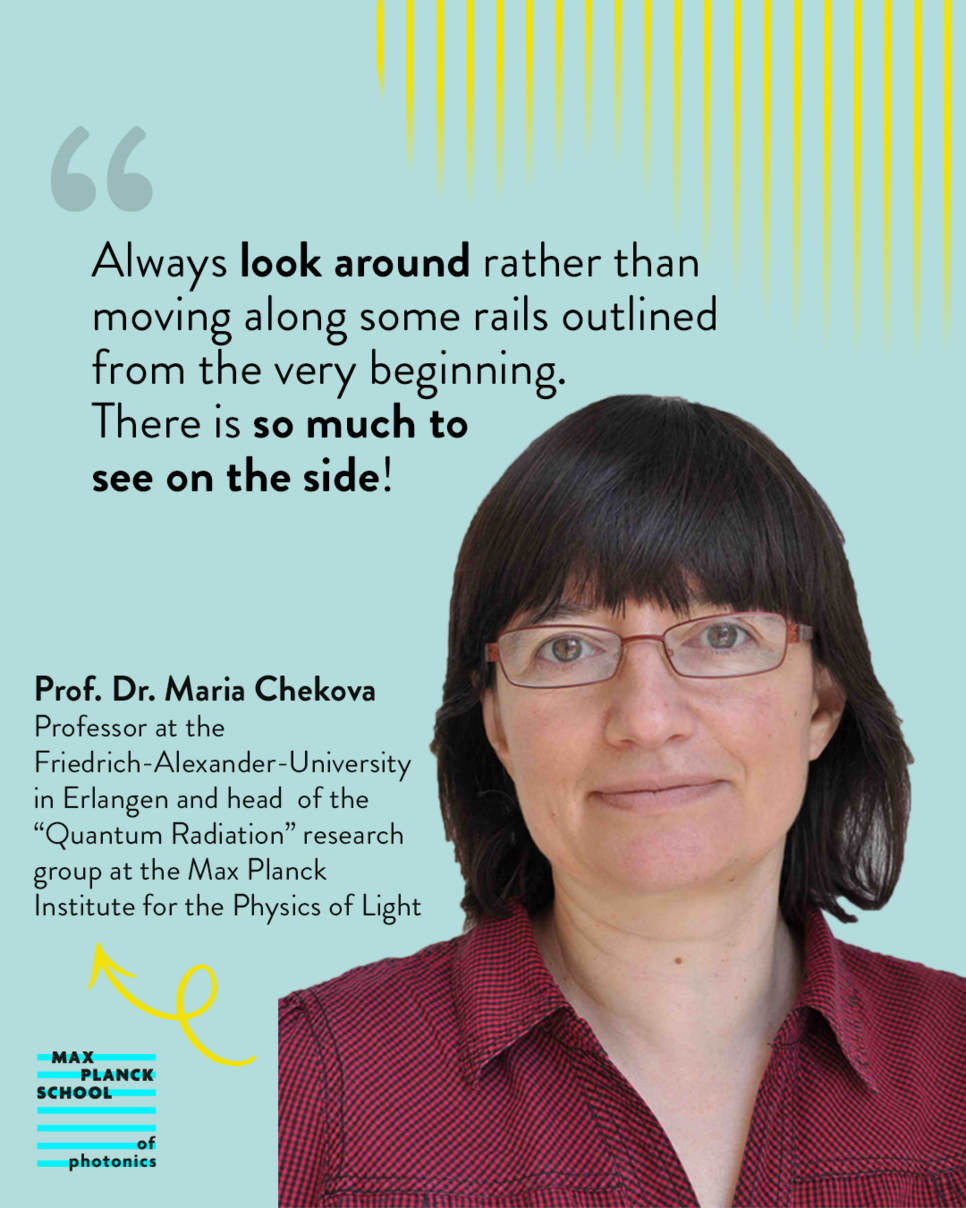
I think they should take a look around and not skip anything. This is related to what I said at the beginning. When you're looking for something in particular, you might not find it, but you might find something else. So, they should always look around rather than moving along some rails outlined from the very beginning. There is so much to see on the side.
How does your research at the MPSP differ from your previous experience in photonics?
My research is the same. It's just the students. Max Planck School of Photonics invests a lot of effort into picking the best students. It is a pleasure to work with such students.
Looking ahead, what excites you most about the future of photonics, and where do you hope your research will take you in the next few years?
I hope to further develop nanoscale quantum optics. But there is another direction that is just starting in my group - strong-field quantum optics. There, we do experiments involving not photons but electric fields - and very strong electric fields, leading to high harmonic generation or driving electrons. This is very exciting because it is ‘terra incognita’, uncharted territory.
Thank you very much for the interview!


